

If you've started researching diamonds, you've probably run into the term "4Cs" almost immediately. It's the industry standard for evaluating a diamond's quality, and understanding it will help you make a confident, informed choice, whether you're working with a jeweler in person or comparing options online.
Here's a clear breakdown of what the 4Cs actually mean, and how to prioritize them for your budget.
What Are the 4Cs?
The 4Cs, developed by the Gemological Institute of America (GIA), are the four factors used to grade and compare diamonds:
Cut
Color
Clarity
Carat weight
Each affects a diamond's appearance and price, but they don't all matter equally, understanding the trade-offs is where you can make smart decisions with your budget.
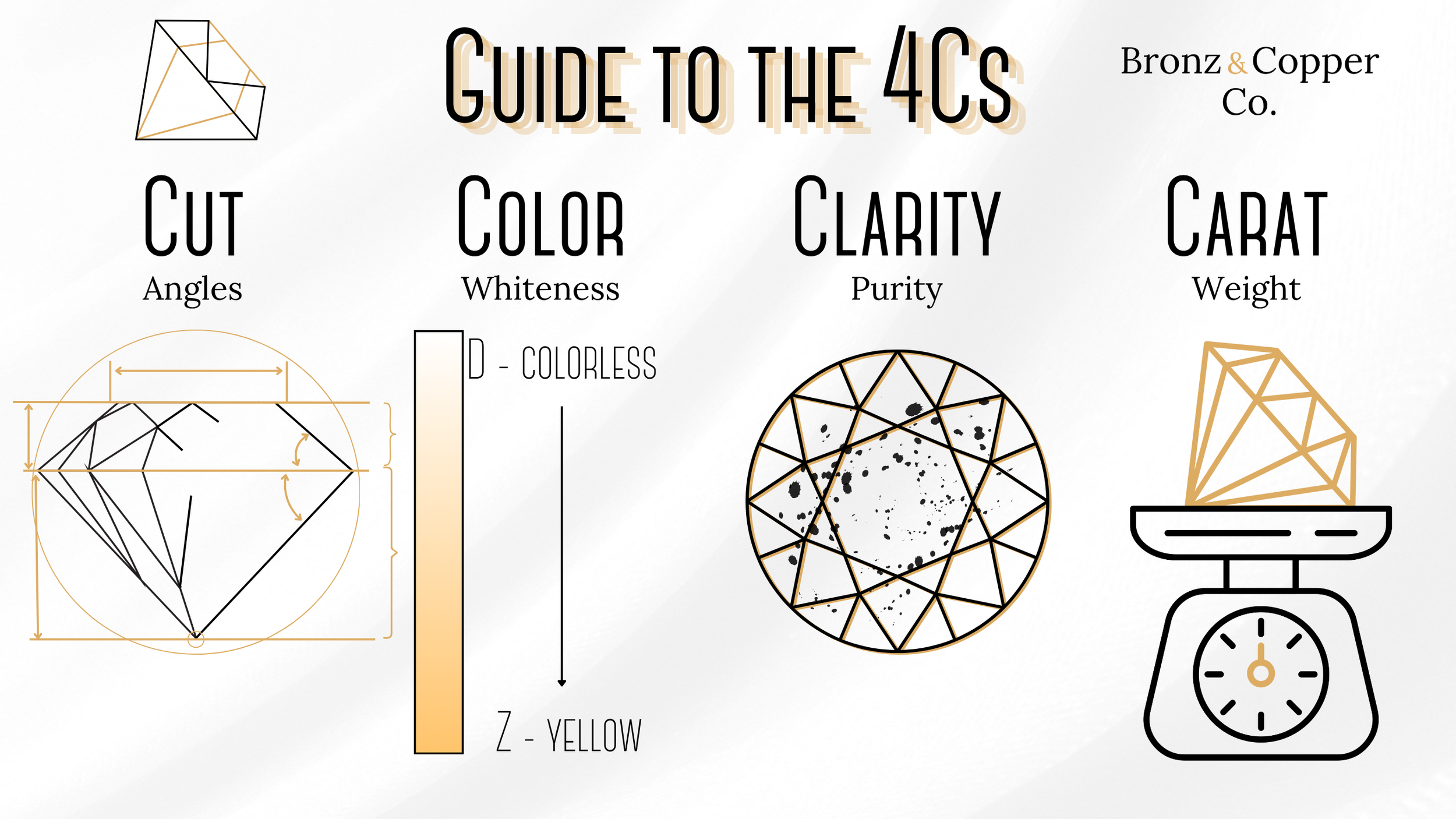
Visual Guide to the 4Cs
Cut: The Most Important C
Cut refers to how well a diamond's facets are proportioned and angled, which determines how well it reflects light. This is not the same as the diamond's shape (round, oval, princess, etc.), cut is about precision and craftsmanship.
Cut is widely considered the most important of the 4Cs because it has the biggest visible impact on a diamond's brilliance and sparkle. A well-cut diamond with a lower color or clarity grade can actually look more brilliant than a poorly-cut diamond with "better" specs on paper.
Cut grades typically range from: Excellent, Very Good, Good, Fair, Poor
Our advice: Don't compromise on cut. It has the most visible effect on how the diamond actually looks, and it's the one factor that can't be "fixed" or improved after the fact.
Color: Grading the Absence of Color
Diamond color is graded on a scale from D (colorless) to Z (noticeably yellow or brown). Colorless diamonds are the rarest and most valuable, but the difference between grades is often subtle to the untrained eye, especially in smaller stones or certain settings.
Color grades typically range from: D-F (colorless), G-J (near colorless), K-M (faint color), and further down the scale
Our advice: For most buyers, a near-colorless grade (G-J) offers excellent value, the color difference from a "perfect" D grade is often imperceptible once the stone is set, especially in white gold or platinum settings, but the price difference can be significant.
Clarity: Measuring Internal and External Characteristics
Clarity refers to the presence of inclusions (internal characteristics) and blemishes (external characteristics) in a diamond. Nearly all diamonds have some, formed naturally during the diamond's growth, but the size, number, and location affect the grade.
Clarity grades typically range from: Flawless (FL), Internally Flawless (IF), Very Very Slightly Included (VVS1/VVS2), Very Slightly Included (VS1/VS2), Slightly Included (SI1/SI2), and Included (I1-I3)
Our advice: Most inclusions in the VS or even SI range are invisible to the naked eye. Unless you're looking for a flawless investment-grade stone, this is often one of the easiest places to save money without sacrificing visible beauty.
Carat Weight: Size, Not Just Sparkle
Carat measures a diamond's weight, not its physical size directly, though the two are related. One carat equals 200 milligrams (1/5 of a gram). Because larger diamonds are rarer, price increases are not linear, a 2-carat diamond typically costs significantly more than double the price of a 1-carat diamond of similar quality.
Our advice: Carat weight is often where buyers feel the most pressure to go big, but a well-cut diamond in the 0.75-1.5 carat range, with strong cut and near-colorless grading, frequently looks more impressive than a larger stone with weaker cut or clarity.
How to Prioritize the 4Cs on a Budget
If you need to make trade-offs (and most buyers do), here's a general order of priority:
Cut — Don't compromise here. It affects brilliance more than any other factor.
Carat — Decide on your ideal size range, then treat it as a flexible target, not a fixed requirement.
Color — A near-colorless grade (G-J) usually offers the best value.
Clarity — VS2 or SI1 typically provides an eye-clean stone at a more accessible price point.
Why This Matters More for Custom Design
When you design a custom ring, you're not choosing from a fixed inventory, you're selecting the diamond and the setting independently. That means you have full control over how you balance the 4Cs against your budget and priorities, rather than accepting whatever combination happens to be available in a pre-made ring.
We'll Help You Navigate It
Understanding the 4Cs is helpful, but comparing actual stones side by side is where it really clicks. When you work with us, we walk you through real diamond options in person or through detailed imaging, so you can see exactly how cut, color, clarity, and carat play out in a stone before you commit.
Ready to Find Your Diamond?
If you're ready to start exploring diamonds and designing your custom ring, Bronz & Copper Co. is here to guide you through every decision, from selecting your stone to seeing the finished piece. Contact us to get started today!